
Analysis of Load Balancing Performance in Raspberry Pi-Based Clustering Services within a Tourism System
Keywords:
Load Balancing, Least Connection, Round Robin, Raspberry Pi, Clustering ServiceAbstract
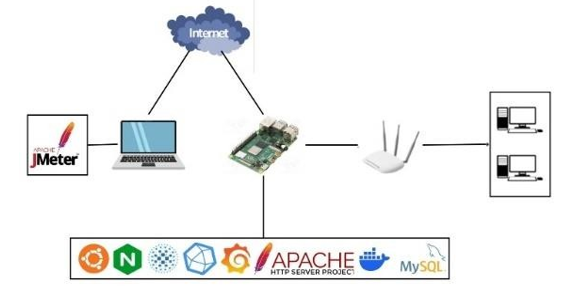
This study analyzes the performance of load balancing on a Raspberry Pi-based clustering service for a tourism e-ticketing system, focusing on the tourist destination in Trenggalek. E-ticketing systems often face challenges such as slow response times, system failures during traffic spikes, and difficulties in efficiently managing server resources. Therefore, this research aims to improve user experience, accelerate the ticket booking process, and optimize both the reliability and performance of the system. The methods used in this study include performance testing of two load balancing algorithms, Round Robin and Least Connection, implemented on a Raspberry Pi cluster server. Testing scenarios covered various load conditions: idle, normal, peak, and maximum, utilizing tools such as JMeter for load testing simulation, and Grafana and InfluxDB for real- time monitoring of system metrics. Key performance indicators analyzed were CPU usage, response time, throughput, memory usage, and error rate. The results indicate that the Round Robin algorithm is effective under light to moderate load conditions but begins to decline in performance under high loads, with response times exceeding 4000 ms and a significant increase in error rates. Conversely, the Least Connection algorithm proved to be more adaptive in distributing the load, maintaining better system stability, although errors still occurred when the system reached maximum capacity. Based on these findings, it is recommended that e-ticketing systems with dynamic and fluctuating loads prioritize the Least Connection algorithm. For future development, it is suggested to explore more advanced load balancing algorithms and increase server capacity to handle larger traffic loads.
Downloads
Downloads
Published
Versions
- 2026-07-20 (2)
- 2026-04-30 (1)
Issue
Section
License
Copyright (c) 2026 Bintang Desta Ramadhani, Norma Ningsih, Haryadi Amran Darwito

This work is licensed under a Creative Commons Attribution-ShareAlike 4.0 International License.