Performance Analysis of Full-Duplex DF Relay-Based D2D Communication with Energy Harvesting
Keywords:
D2D, Full Duplex, Energy Harvesting, Power Splitting Relaying, Decode and Forward ProtocolsAbstract
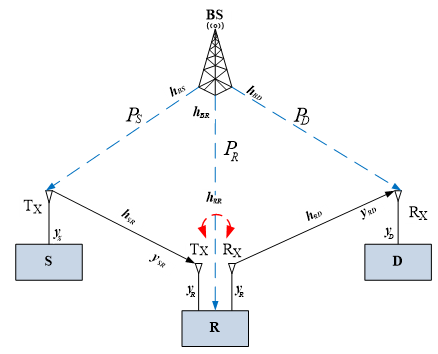
Device-to-device (D2D) communication is a promising technology that leverages spectral efficiency and relieves network congestion in next-generation wireless systems. However, it suffers from significant performance degradation under Interference and limited transmission power and energy limitations, especially in the suburban areas with non-line-of-sight (NLOS) propagation conditions. To tackle these challenges, this paper studies a full-duplex D2D communication system with an energy-harvesting decode-and-forward (DF) relay based on the power-splitting relaying (PSR) protocol. The system model enables simultaneous information and energy transfer using radio-frequency (RF) signals as the energy source. We examine two scenarios: a relay-assisted self-interference model and a multi-node interference model. We evaluate system performance in terms of signal-to-noise ratio (SNR), throughput, and outage probability for different energy-harvesting efficiencies, power-splitting factors, and time-allocation parameters. Simulations show that system performance rises with energy-harvesting efficiency. We also identify optimal power-splitting and time-allocation values for maximum throughput. In the full-duplex DF relay system, self-interference is present at the relays, yet spectral efficiency improves. However, multiple nodes cancel each other out, causing a drop. These results help design effective, energy-efficient D2D communication systems with near-optimal performance for future wireless networks.
Downloads
Downloads
Published
Versions
- 2026-07-20 (2)
- 2026-04-30 (1)
Issue
Section
License
Copyright (c) 2026 Afina Nabila Dirganingsih, Anang Budikarso, Yoedy Moegiharto, Mohammad Ridwan, Faridatun Nadziroh, Budi Aswoyo

This work is licensed under a Creative Commons Attribution-ShareAlike 4.0 International License.