Automatic Control of Oxygen Flow for Hypoxemia Therapy Based on Fuzzy Method
DOI:
https://doi.org/10.68129/jeis.v1i1.2Keywords:
Automatic control of oxygen flow, Blood oxygen saturation, Fuzzy logic controller, Hypoxemia, Respiratory rateAbstract
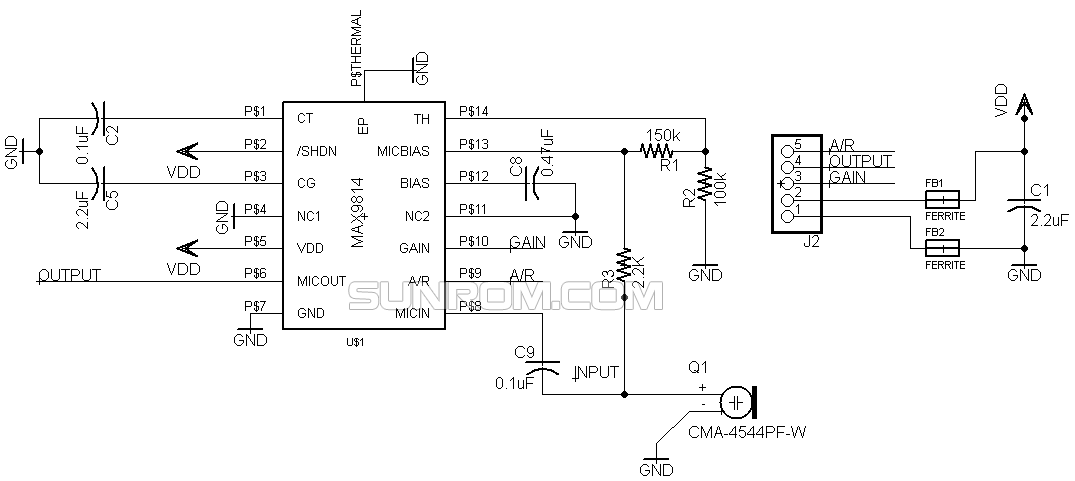
Hypoxemia is a serious condition that requires oxygen transfusion. Indiscriminate oxygen administration is a poor strategy that can increase organ damage and even death. This paper describes a system for automatically controlling airflow of an oxygen tubes to a patient based on blood oxygen saturation and respiratory rate measurements. The MAX30102 sensor is used to measure oxygen saturation levels, and the MAX9814 module is used to determine respiratory rate. Both sensor outputs are processed by an STM32F411 microcontroller, and then sent wirelessly to an Arduino Uno microcontroller, which implements the fuzzy logic controller to control oxygen flow. The fuzzy output is used to activate a motor servo that controls the oxygen tube valve opening. The valve opening width (in degrees) is divided into 5 categories. Communication between the microcontroller and the valve actuator uses a 433MHz wireless RF module. The device test results revealed an MAE of 0.40% for oxygen saturation measurements compared to standard hospital measuring instruments and an MAE of 0.47% for respiratory rate measurements compared to manual measurements. Overall system testing produced a valve opening with an MAE of 0.56% compared to simulation results using MATLAB.
References
[1] Jialin Mao, et al, "Risk Factors and Treatment Strategies of Postoperative Hypoxemia in Acute Type A Aortic Dissection: A Literature Review," Heart Surgery Forum, vol. 28, no. 9, 2025. https://doi.org/10.31083/HSF46934.
[2] Hamish R Graham, et al, "The prevalence of hypoxaemia in paediatric and adult patients in health-care facilities in low-income and middle income countries: a systematic review and meta-analysis," The Lancet Global Health, vol. 13, no. 2, pp. E222-E231, 2025.
[3] C Morano, et al, "Hypoxic Status in COPD and ARDS Patients: Impact on Lipid Signature," International journal of molecular sciences, vol. 26, no. 13, 2025. https://doi.org/10.3390/ijms26136405.
[4] Binh Nguyen, et al, "Controlling mechanical ventilation in acute respiratory distress syndrome with fuzzy logic," Journal of Critical Care, vol. 29, no. 4, pp. 551-556, August 2014. https://doi.org/10.1016/j.jcrc.2014.03.009.
[5] F Lellouche, et al, Conventional Oxygen Therapy: Technical and Physiological Issues, Springer Nature, 2021. https://doi.org/10.1007/978-3-030-42454-1_1.
[6] Daniel Sanchez-Morillo, et al, "Physiological closed-loop control in intelligent oxygen therapy: A review," Computer Methods and Programs in Biomedicine, vol. 147, pp. 101-108, 2017.
[7] Oriol Roca, et al, "Closed-loop oxygen control improves oxygen therapy in acute hypoxemic respiratory failure patients under high flow nasal oxygen: a randomized cross-over study (the HILOOP study)," Critical Care (Springer Nature), vol. 26, no. 108, 2022. https://doi.org/10.1186/s13054-022-03970-w.
[8] Sandal O, et al, "Closed–loop oxygen control improves oxygenation in pediatric patients under high–flow nasal oxygen—A randomized crossover study," Intensive Care Medicine and Anesthesiology (Frontier Med.), vol. 9:1046902, 2022. https://doi.org/10.3389/fmed.2022.1046902.
[9] Daniel Leite, et al, "From Model-Based and Adaptive Control to Evolving Fuzzy Control," 07 June 2025. [Online]. Available: https://arxiv.org/html/2506.06594v1. [Accessed 15 April 2026].
[10] Binh Nguyen, et al, "Controlling mechanical ventilation in acute respiratory distress syndrome with fuzzy logic," Journal of Critical Care, vol. 29, no. 4, pp. 551-556, August 2014. https://doi.org/10.1016/j.jcrc.2014.03.009.
[11] Troy Kettle, et al, "Fuzzy logic in respiratory medicine: a systematic review of predictive and diagnostic applications," International Journal of Medical Informatics, vol. 212 (106347), 2026. https://doi.org/10.1016/j.ijmedinf.2026.106347.
[12] Kaltsogianni, O., Dassios, T., & Greenough, A, "Closed-Loop Automated Oxygen Control in Preterm Infants Receiving Non-Invasive Respiratory Support," Children (MDPI Journal), Vols. 12(11), 1528, 2025, https://doi.org/10.3390/children12111528.
[13] AK Pal, et al, "Precise oxygen therapy to emphysema patients by fuzzy-based gain tuning control of set-point regulated MRAC," Computers in Biology and Medicine (Elsevier), vol. 206: 111608, 2026. https://doi.org/10.1016/j.compbiomed.2026.111608.
[14] Sita Radhakrishnan, et al, "Analysis of parameters affecting blood oxygen saturation and modeling of fuzzy logic system for inspired oxygen prediction," Computer Methods and Programs in Biomedicine (Elsevier), vol. 176, pp. 43-49, July 2019. https://doi.org/10.1016/j.cmpb.2019.04.014.
[15] Ibrahim M. Mehedi, et al, "Fuzzy PID Control for Respiratory Systems," Journal of Healthcare Engineering, vol. 7118711, 2021. https://doi.org/10.1155/2021/7118711.
[16] Dini, Mazaya Zata, et al, "Detection of Oxygen Levels (SpO2) and Heart Rate Using a Pulse Oximeter for Classification of Hypoxemia Based on Fuzzy Logic," Jurnal Ilmiah Teknik Elektro Komputer dan Informatika (JITEKI), vol. 8, no. 1, pp. 17-26, March 2022. https://doi.org/10.26555/jiteki.v8i1.22139.
[17] Sunrom Electronics Technology, [Online]. Available: https://www.sunrom.com/media/content/1120/max9814-schematic.gif. [Accessed 15 April 2026].
[18] Maxim, [Online]. Available: https://www.alldatasheet.com/html-pdf/859400/MAXIM/MAX30102/151/1/MAX30102.html. [Accessed 15 April 2026].
[19] L. M. Engineer, "Arduino Project," [Online]. Available: https://lastminuteengineers.com/max30102-pulse-oximeter-heart-rate-sensor-arduino-tutorial. [Accessed 15 April 2026].

Downloads
Published
Issue
Section
License
Copyright (c) 2026 Rika Rokhana, Santi Anggraini , Retno Sukmaningrum , Hary Oktavianto , Paulus Susetyo Wardana , Agrippina Waya Rahmaning , Moch. Rochmad , Kemalasari , Hendhi Hermawan Efendi, Zainal Arief (Author)

This work is licensed under a Creative Commons Attribution-ShareAlike 4.0 International License.